What Rattan Actually Is
Rattan is a climbing palm that grows in the tropical forests of Southeast Asia, Cambodia included. It is not a tree and it is not bamboo: it is a vine, sometimes two hundred metres long, that hooks itself onto surrounding trees to reach the light.
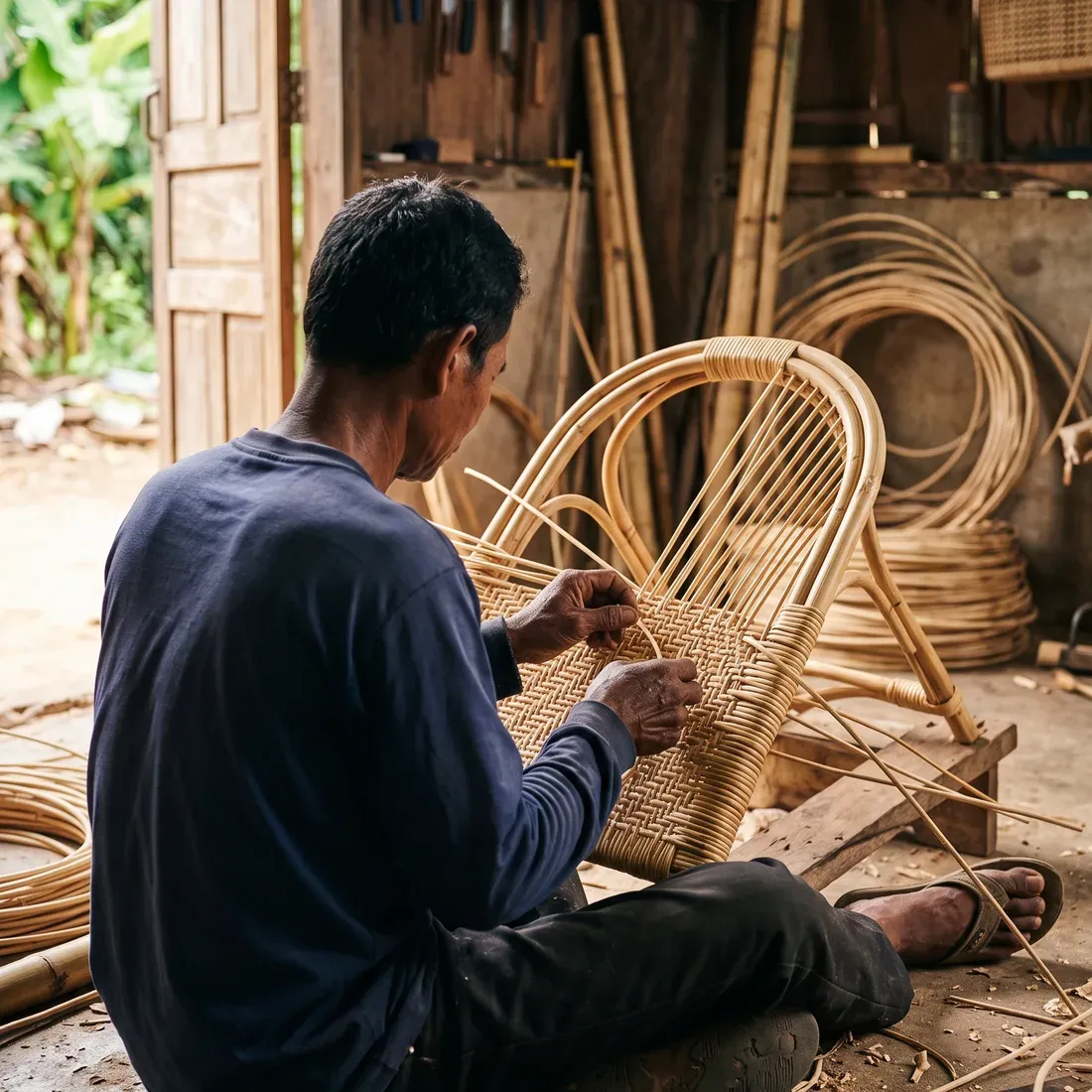
Cut, cleaned and heated, its stem bends — and stays bent once it cools. That single property is why a rattan chair can be curved from one continuous piece, with no joints and no screws.
The outer skin is peeled off in strips and used for the weaving; the solid core becomes the frame.
Almost everything sold as rattan today is neither rattan nor woven by hand — it is extruded plastic on an aluminium frame. This page explains the difference, where the real material comes from, and why it matters when you buy.
Rattan, wicker, bamboo
Three words people use as if they meant the same thing
Rattan
A material — a climbing palm
- Structure
- Solid
- Bends
- Yes, with heat
- Used for
- Curved frames, weaving
Bamboo
A material — a giant grass
- Structure
- Hollow
- Bends
- No, it snaps
- Used for
- Straight poles, shades
Wicker
Not a material — a weaving technique
- Structure
- —
- Bends
- —
- Used for
- The weave itself
Wicker is not a material. You can weave wicker out of rattan, bamboo, willow or plastic — the word only describes how it was made, never what it is made of.
Where It Comes From
Rattan only grows in living forest. The vine needs standing trees to climb — which means a rattan harvest, done properly, is a reason to leave the forest standing rather than clear it.
Cambodia has several native species, including one used around the Tonlé Sap and in the Siem Reap region.
That is the theory. In practice the resource has been declining across mainland Southeast Asia for two decades, as forest cover shrinks. Global cane imports have fallen sharply since 2005, and Indonesia is now the only producer where volumes hold up. What this means for a buyer is simple: real rattan is becoming scarcer and more expensive, while its plastic imitation gets cheaper every year.
The Chair That Was Never Rattan
- 1917
In Michigan, a manufacturer named Marshall Burns Lloyd had a problem: the First World War had cut off his rattan supply from Asia. Rather than wait, he twisted kraft paper around a steel wire and had it woven by machine, in large sheets. He called it Lloyd Loom and patented it the same year — rattan had always been woven by hand, piece by piece; the machine produced square metres of it.
- 1940
Around ten million pieces had been made in Britain and the United States. Hotels, restaurants, tea rooms, ocean liners — even a Zeppelin.
- Today
Rattan did not lose because it was worse. It lost because someone worked out how to manufacture its appearance, out of paper. The extruded plastic furniture sold as rattan today is the direct descendant of that 1917 patent.
Four Ways to Tell
You can do all four in under a minute, in any shop
Look at the cut end
- ✓ Real rattan
- Fibrous core, like wood
- ✗ Imitation
- Smooth uniform section, or a hollow tube
Follow one strand
- ✓ Real rattan
- It stops, knots, starts again
- ✗ Imitation
- Endless, no join anywhere
Touch it
- ✓ Real rattan
- Warm, slightly irregular
- ✗ Imitation
- Cold, smooth, perfectly regular
Find the frame
- ✓ Real rattan
- Curved rattan, no visible screws
- ✗ Imitation
- Aluminium tube, screwed together
What We Sell
Everything in this shop is natural fibre: rattan, bamboo, water hyacinth, reed. Nothing extruded, nothing on an aluminium frame. The pieces come from weavers in Siem Reap province.
It is not the cheapest option, and it is not meant to be. A rattan frame can be repaired; a cracked plastic one goes to landfill.